
Smith County Criminal Docket Searches
Kansas CaseSearch is the official starting point. Accept the terms, pick District, and choose Smith County. If you know the full identifier, search by Case Number. Party Name works without it, and Citation Number suits a complete state ticket. Open Additional Search Filters and select Criminal to trim the results. Finish the human check first. Only then does Search become active. Should the online search fail, try the public terminal at the courthouse. You can also call the Clerk of the District Court at 785-282-5140. Or send a focused written request. A municipal charge goes through the issuing city clerk instead.
- Choose District and Smith County.
- Select Case Number, Party Name, or Citation Number.
- Enter the exact term and choose Criminal.
- Complete the human check and open the match.
- Read events in date order and request needed documents.
Smith Criminal Search Fields
The current CaseSearch application splits its form into court, search type, term, county, and optional filters. The blank interface holds no private result.
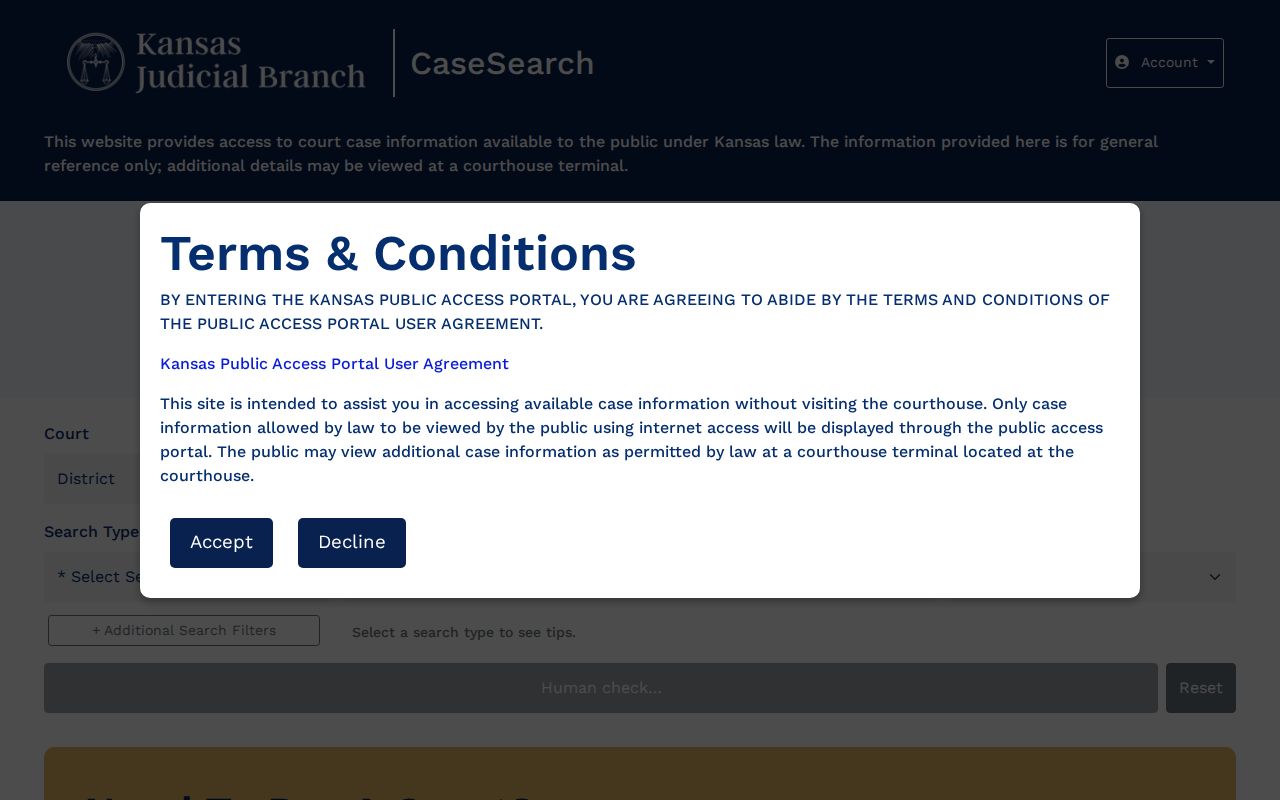
A disabled Human check button is a technical gate, not proof that a Smith County case is missing.
| Field | Criminal use |
|---|---|
| Court | District |
| Search Type | Number, name, or citation |
| County | Smith County, code SM |
| Case Type | Criminal |
| File dates | Narrow broad results |
Criminal Dockets: What They Show
Kansas labels the chronological list an events index. Case number, type, parties, attorneys, judge, hearing dates, and public events can all appear there. Images show up when internet access is allowed. A missing image does not mean the event never occurred, though. Some public material stays off the online record. For that, try the terminal or a record request.
| Case number | SM-2024-CR-000123 is the newer model |
|---|---|
| Charge | Filed allegation and statute when public |
| Setting | Date and event label, subject to reset |
| Plea | Recorded plea, not a sentence |
| Disposition | Recorded result |
Read the exact words on the entry. Filed is not proved, a motion is not a ruling, and an appeal is not a reversal.
Smith Criminal Number Clues
Smith County switched to the Odyssey format in 2022. Newer numbers may open with SM, then the year, the case type, and six digits. CR is the official Criminal identifier. Enter punctuation exactly as the record shows it. The court publishes no Smith event-code glossary.
- CR
- Criminal case type.
- Events index
- Date-ordered case activity.
- Setting
- A scheduled event that may move.
- Disposition
- The result recorded by the court.
- Certified copy
- A clerk-authenticated record.
Use plain descriptions unless the live Smith County criminal docket defines an abbreviation.
Criminal Case Stages on the Docket
A case opens with a complaint, information, or indictment. A citation can open one too. An initial appearance or arraignment may come next. Bond orders, attorney entries, motions, pretrial settings, and continuances then land in time order. Plea or trial activity can end in dismissal, acquittal, conviction, diversion-related action, or another result. Sentencing follows when it applies. Later you may see payment, review, restitution, appeal, or expungement entries.
Docket flow: Charge Filed › Arraignment › Pretrial › Plea or Trial › Disposition › Sentencing
Not every Smith County case hits every stage. A public event can stay visible while its sensitive attachment stays restricted.
Smith Charges and Outcomes Differ
Charge text, disposition, and sentence answer different questions. The charge states an allegation. The disposition records how the charge ended. A sentence states the order entered after a conviction or accepted plea. Blend them together and you can reach a false conclusion.
| Entry | Safe reading | Do not infer |
|---|---|---|
| Arraignment | Early appearance | Guilt |
| Plea accepted | Plea recorded | Exact sentence |
| Dismissed | Charge ended as stated | Reason not shown |
| Appeal filed | Review began | Reversal |
Ask the Smith County clerk for a certified judgment, and remember that a transcript is a separate record from the court docket itself.
Smith County Criminal Docket Courts
State felony, district misdemeanor, traffic, fish-and-game, juvenile, and related records sit with the Smith County District Court at 218 S. Grant, subject to restrictions. The district magistrate judge works inside that structure. Kansas runs no separate Smith county-court or justice-of-the-peace portal. Municipal ordinance cases belong to Smith Center, Kensington, Gaylord, Lebanon, or Athol. K.S.A. 12-4104 defines municipal jurisdiction. An appeal may reach District Court, but the first city file stays local.
District Court Clerk
218 S. Grant, PO Box 273
Smith Center, KS 66967
785-282-5140
Smith and Federal Criminal Dockets
Federal cases never appear in CaseSearch. The U.S. Attorney’s Office for Kansas sits in the separate federal system, which handles its own charging records and dockets.
Federal docket access runs through the U.S. District Court and PACER. A Smith state charge stays in District Court.
Access Rules for Criminal Dockets
Kansas Rule 22 sorts case information into three tiers. Some data is open on the public internet, and more is available at a courthouse terminal. The rest is nonpublic. No terminal can undo a seal, and juvenile, expunged, or otherwise restricted cases may simply not show up.
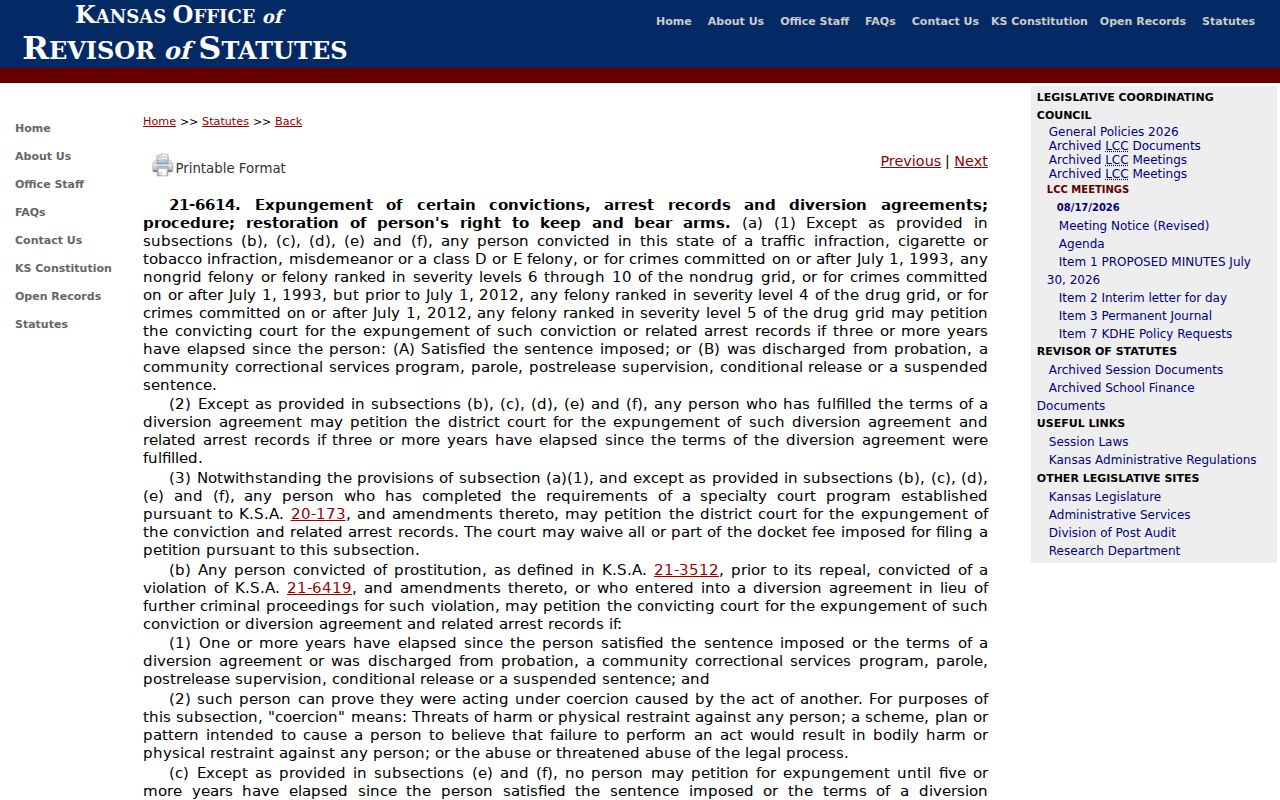
The conviction-expungement statute shows one common path by which a case drops out of public view altogether.
Arrest expungement is separately addressed by K.S.A. 22-2410.
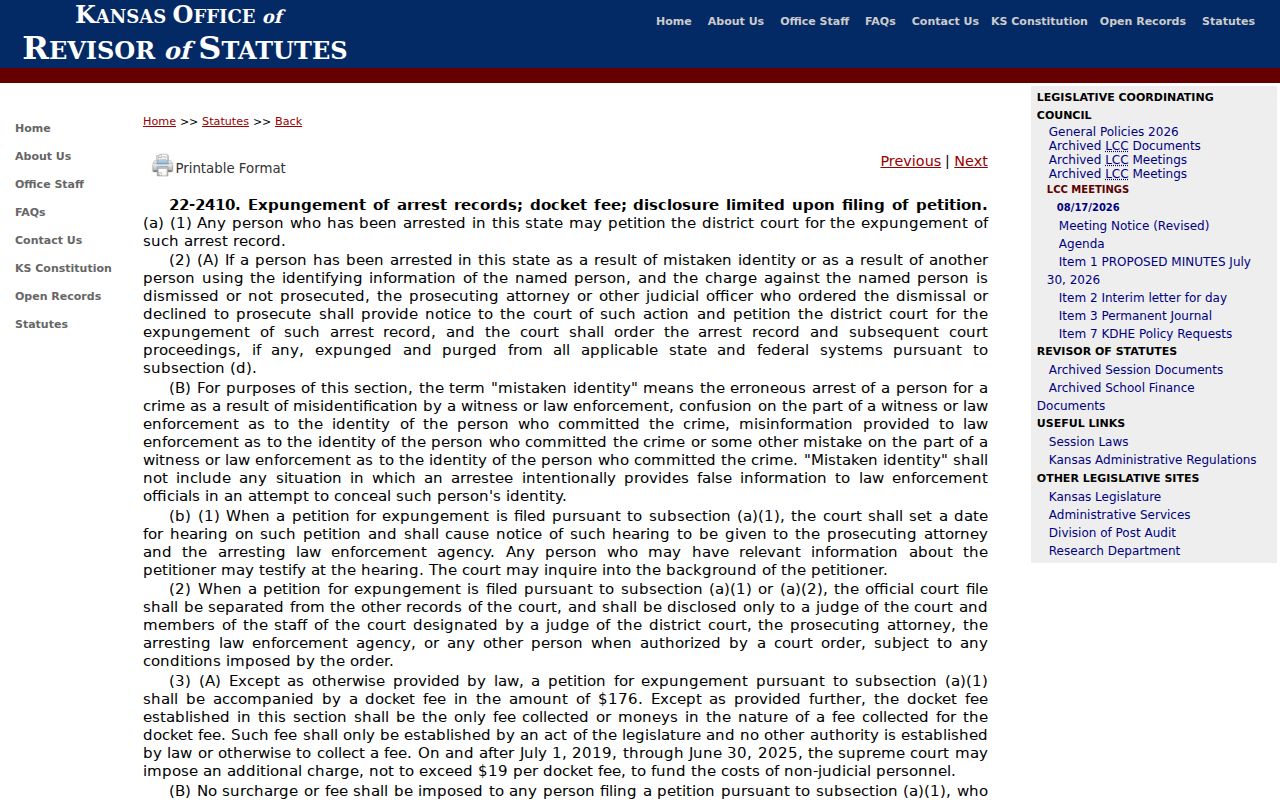
Sealing and expungement differ. A blank result does not prove that no case exists.
Access rule: The terminal can reveal more public data, while restricted records remain unavailable without lawful authority.
Smith Criminal Document Requests
A document request works best when it is specific. On the Kansas court KORA form, list the court and the case number. Name the exact document and its date. Add how you want it delivered, plus your contact information. Send it to the District Court clerk and ask for a cost estimate first. Two other offices come up short for this task. The elected County Clerk keeps county government records rather than criminal files. The Central Payment Center only processes payments. And eFlex serves authorized filers rather than the general public.
Two statutes drive the timeline and the fees. K.S.A. 45-218 gives the office until the end of the third business day to respond. That response may hand over the record, explain a delay, or state the earliest date it will be available. K.S.A. 45-219 permits reasonable charges for copying and service. Advance payment can be required. A tight, focused request helps whoever handles the Smith County criminal docket pull the precise filing or order without guesswork. If anything is withheld, ask which statute, rule, or order supports that call. Ask whether the open parts can be split out.
Older Smith County criminal cases sometimes show index details but no images you can download. Begin with the case record. Then try the terminal at the courthouse. Request a plain copy when certification does not matter, and a certified copy when clerk authentication does. For testimony word for word, the court reporter is the person to ask. Remember that the events index is only a chronology. A payment balance sitting in another system says nothing about the final case result.
Blank results usually point to search settings, not a dead end. Check the full number, the District selection, Smith County, and the Criminal filter. Then consider whether the matter is municipal, restricted, expunged, older, or filed under a different spelling. The issuing city handles ordinance charges. The Smith District Court clerk handles state charges. Working through that sequence keeps you from reading a missing webpage as a legal outcome.
The court-record form is built for asking about a known document, not for having staff research a legal question. Describe what you want in plain terms: a complaint, an order, a judgment, a sentence, or another entry. When a public event appears but an attachment is restricted, the clerk can explain the access category. No protected content gets opened. Rule 22 still controls. The terminal adds public access; it is never a way around confidentiality.
Note: A portal image on your screen is not a certified judgment, and an events index is not a word-for-word transcript.
Smith Criminal Search Cross-Checks
Do not conclude a record is missing after one attempt. Repeat the Smith County docket search using the full case number, the portal's official name syntax, and Smith County. Then apply the Criminal filter. Confirm whether the charge came under state law or a city ordinance. Older files, restricted cases, expunged matters, and a failed human check each point to a different official fallback. A city citation goes to that city clerk. A state charge goes to the Smith County District Court clerk.
Tie every result to its exact court and date. Later events can change a hearing setting, a payment status, or an appeal posture. A saved search result may go stale. Check the events index again before relying on any date or outcome, and match each key conclusion to the signed public order or certified judgment behind it.
The Smith County docket can stay active long after sentencing. A payment entry, probation review, restitution event, modification, appeal, or expungement filing adds to the chronology. Nothing gets erased. Read forward to the latest public event. If that event is unclear, cite it by date and title when you contact the clerk. That habit keeps the index's report distinct from what the underlying document actually orders.