
Smith County Court Record Requests
Begin your Smith County docket search at Kansas CaseSearch, and write down the case number plus the exact event you need. Documents missing from the site often sit at the courthouse public terminal. Want a copy? Send the Kansas court KORA form to the District Court clerk. Tell the clerk whether you want email, mail, pickup, or fax, and say plainly whether the copy must be certified or plain.
- Identify Smith District Court or the correct city court.
- Search the public case information and note the event.
- Check the courthouse terminal for more public material.
- Describe the exact document, date, case number, and delivery choice.
- Ask for a cost estimate and pay the quoted amount when required.
Three Smith County Record Products
One phrase, three products. The events index is just a list of activity in a case. The filed document is the real thing. That means the pleading, motion, order, judgment, return, or exhibit itself. A certified copy adds the clerk's authentication, which formal uses demand. Spotting an event in the index does not mean its document can be downloaded.
| Product | What it provides | Best source |
|---|---|---|
| Events index | Chronological case activity | CaseSearch or terminal |
| Filed document | Full text of a public file item | Viewer, terminal, or clerk |
| Certified copy | Clerk-authenticated reproduction | District Court clerk |
Kinds of Court Records
The Smith County District Court holds the public portions of several file types. Those include criminal, civil, family, probate and mental-health, traffic, fish-and-game, juvenile, and small-claims records. Access follows Kansas Rule 22, the statutes, and any court order in the case. Transcripts are a separate animal. Ask the court reporter who covered the hearing. A docket entry proves the hearing happened but never reproduces testimony.
CaseSearch shows documents created after the court joined Kansas eCourt. Older material may still wait at the courthouse even with no PDF online. Smith moved to Odyssey on July 11, 2022. That date alone proves nothing about earlier records disappearing.
District Clerk, Not County Clerk
The Clerk of the District Court keeps the judicial files. Ashley Maxwell, the elected Smith County Clerk, handles county administrative, election, and government records instead. City clerks hold municipal ordinance cases. Federal clerks hold federal files. Send a pleading request to the county-government form and you lose days.
So route by who created the record. Pleadings, judgments, and docket events belong with the District Court clerk. Traffic files, civil files, criminal files, and certifications belong there too. County commission and election material goes to the County Clerk. A municipal ordinance ticket goes to its city clerk or municipal court. Federal cases go to the federal clerk and PACER.
The split also decides the form and fee schedule. The Smith County government request form carries its own charge worksheet. It has staff-time fields and fulfillment tracking too. None of that sets District Court copy prices. On a mixed project, split the request by custodian and describe each record separately. Each office then gets a clear scope. One KORA form never becomes a universal court-record order. The official Smith County Clerk page shows that separate office:
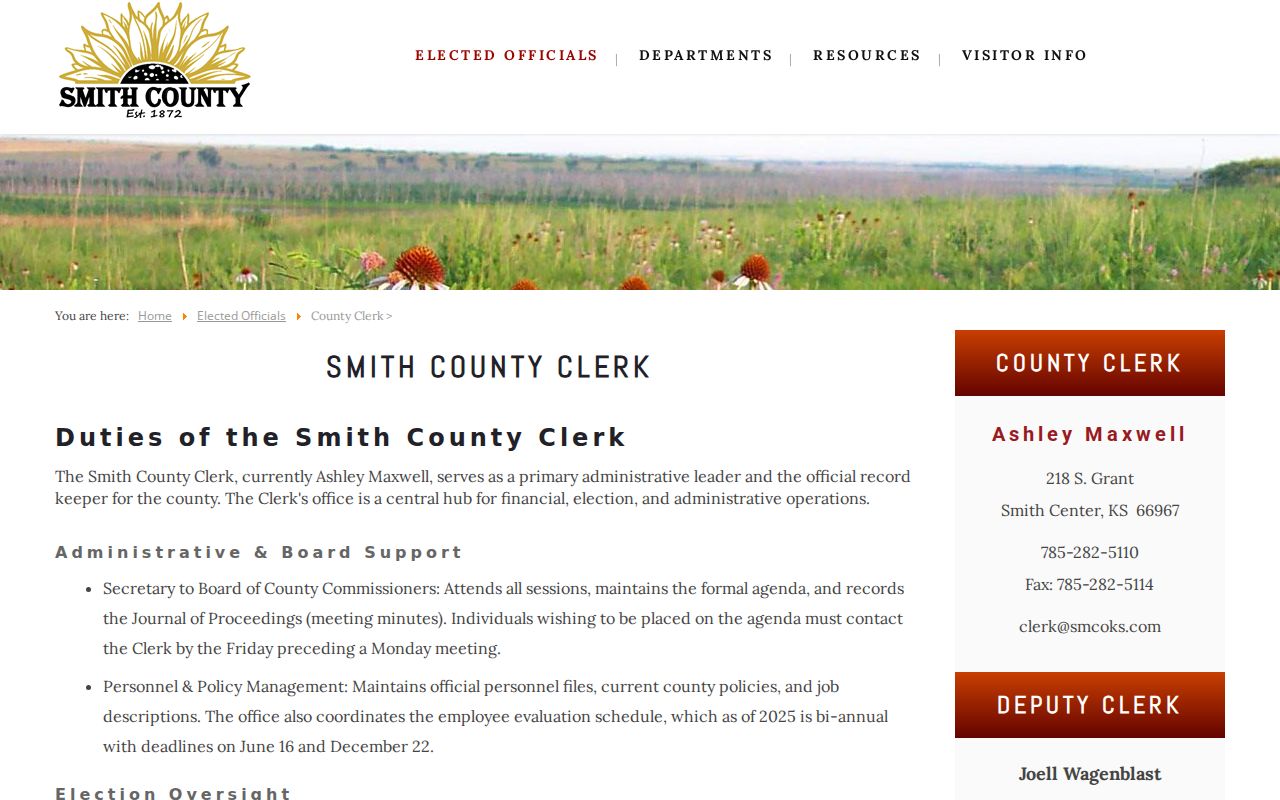
Use that office for county records, not District Court judgments or docket copies.
Court Records: What They Contain
A Smith County court file can hold a lot. The case header, parties, attorneys, and assigned judge come first. Beyond those sit filings, service returns, settings, orders, judgment, disposition, payments, and appeal events.
| Header | Case number, court, type, filed date, status |
|---|---|
| Events | Dated filings, hearings, orders, and outcomes |
| Documents | Public pleadings and signed orders when available |
| Settings | Date, time, courtroom, judge, and setting type |
| Certification | Clerk authentication requested separately |
Smith County KORA Timing
K.S.A. 45-218 sets the response clock for records requests. Three business days starts it. Full production that fast is not promised: the custodian may instead reply with availability, a cost estimate, a delay explanation, or a lawful denial, and complex, archived, sealed, or oversized requests can take longer.
The Smith County open-records policy concerns county government:
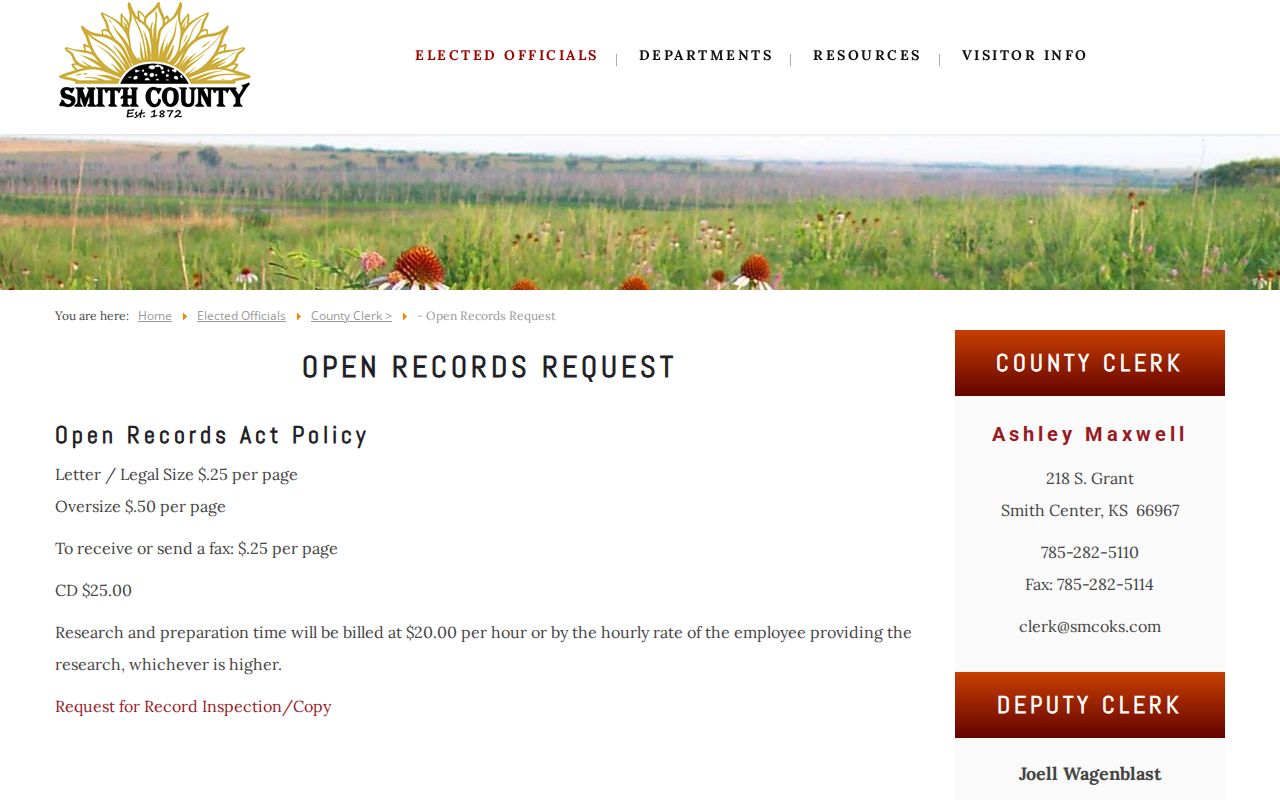
For court documents, use the judicial form and District Court clerk instead.
Copy Fees and Certification
The official 17th Judicial District reference spells out the pricing. Searching at the terminal is free. Printed terminal pages cost $0.25 each, and certification runs $1 per document. Bigger requests can trigger a $5 research charge. Confirm the current Smith County application before you order. KORA lets the office charge its actual reproduction and service costs, with advance payment allowed.
| Item | Published district reference |
|---|---|
| Terminal search | Free |
| Printed page | $0.25, confirm Smith |
| Larger-request research | $5 may apply, confirm Smith |
| Certification | $1, confirm Smith |
| Transcript | Court reporter quote required |
K.S.A. 45-219 governs copies and fees:
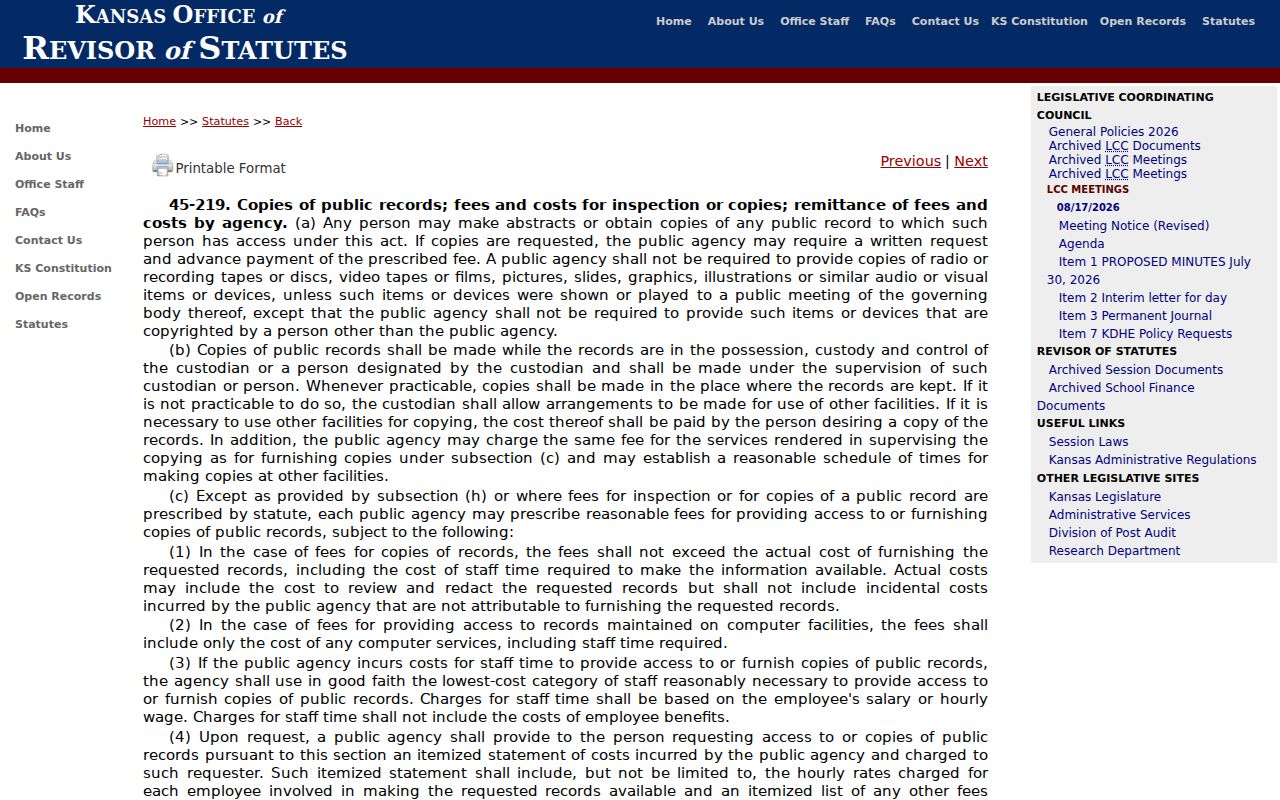
The statute supports estimates and advance payment, not an invented flat Smith fee.
Older Smith County Files
Smith County posts no local retention schedule, microfilm list, archive address, or historic docket index. So call the District Court clerk. Ask whether an older file still sits at the courthouse or has moved to an archive. Ask what a search would cost. Ask whether the clerk can certify the document you want. Have an approximate year ready, plus a party name or case number. Name the exact document you seek.
Don't assume every pre-2022 record has vanished. Case information and paper files can survive even where nothing lives online. A courthouse terminal plus a talk with the clerk is the best fallback.
Smith County Form Procedures
K.S.A. 45-220 addresses agency procedures and written requests:
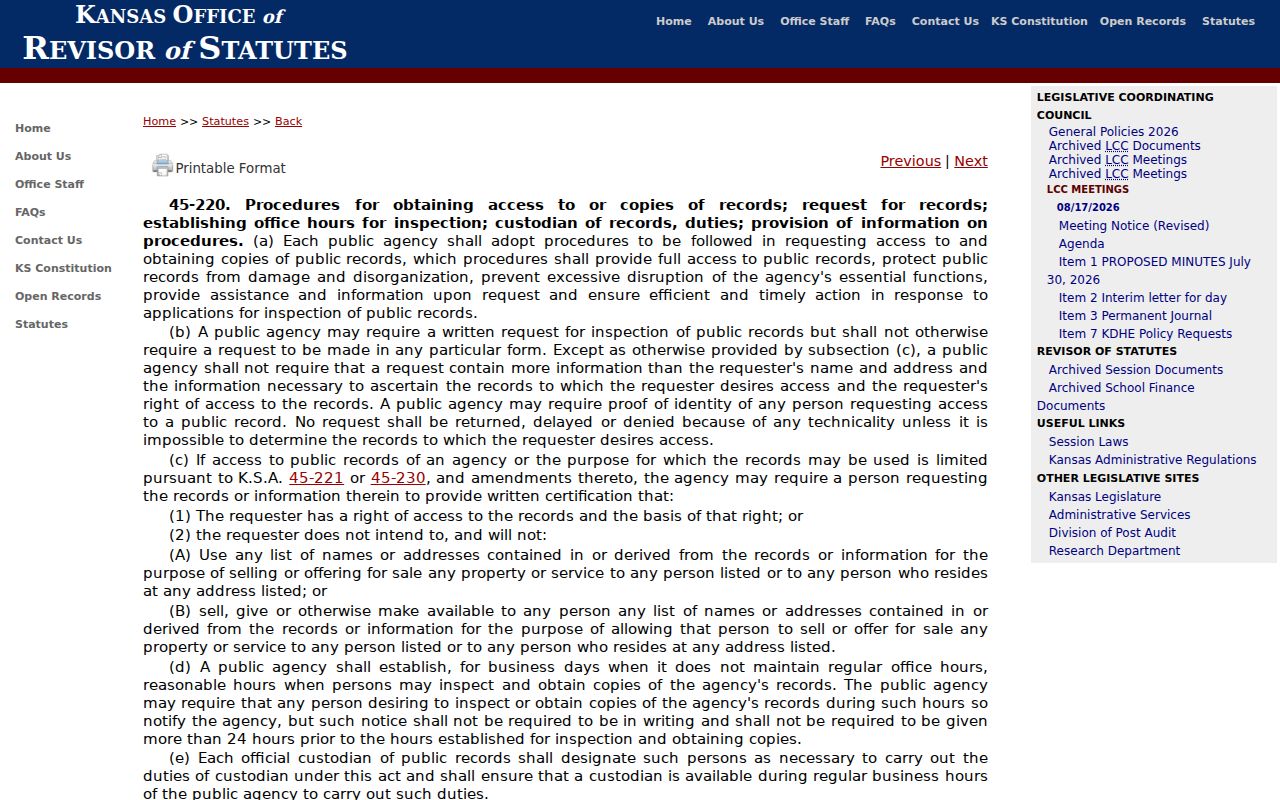
Filling out the Smith County request form takes a few minutes. You will give your name and contact information. Pick how you want the records delivered, and describe exactly what you need. Sign it, date it, and confirm the request is for noncommercial use. The form makes no promise of a fixed turnaround. It also does not say a copy of government ID is always required.
Be specific about what you want from the docket. Inspection, copies, or both. If you need just one signed order, name that order. Certification has to be requested in those words. So write "certified copy" and point to the exact judgment, order, or docket entry. Exhibits sometimes carry restrictions. When the clerk cites one, take the redacted or segregated portion that remains public.
Access Rules for Court Records
Kansas Rule 22 governs public electronic court records. Under K.S.A. 45-221, exemptions separate open material from protected portions.
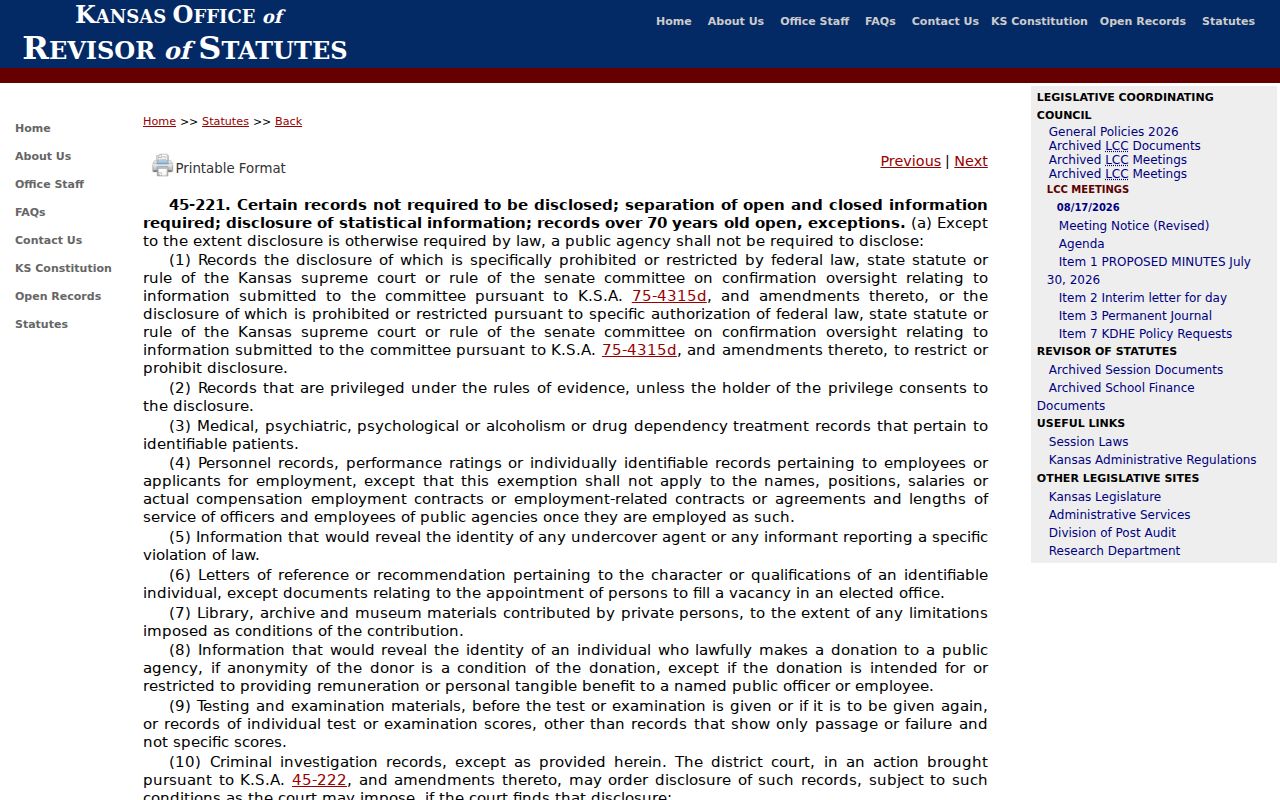
Some material in a court record simply is not public. Sealed files, confidential case types, protected identifiers, and anything restricted by order can be withheld. Some of it may be redacted instead. That is not a failed docket search. Ask for the public portion. Also ask the clerk to cite the authority behind any denial.
Access boundary: CaseSearch is public information, the courthouse terminal may show more, and the District Court clerk holds the official Smith County file.
Clerk of the District Court
Smith County District Court
Smith Center, Kansas
Use the clerk for pleadings, judgments, event copies, certifications, and older District Court files.
Smith County Document Boundaries
The Smith County CaseSearch application lists docket events and offers a document viewer. Treat any promise of free petitions, orders, judgments, or exhibits with caution. The viewer's document access sits behind a human verification step. Kansas district-record guidance states the safer rule. Rule 22 lets certain public case information appear online. A courthouse terminal may offer more public material. Older records or filed documents may still require a request to the District Court clerk.
No official Smith-specific price covers internet document images, bulk subscriptions, or archive retrieval. Ask the clerk for a quote. Name the exact event and document you want. Avoid asking for everything. A good request identifies the signed judgment entered on a known date. It might name a motion by its title or the public docket events for a stated period. A narrow scope helps the clerk locate the right item and produces a more useful cost estimate.
The Kansas KORA form promises no fixed production date. It asks for your contact information, a delivery choice, an exact record description, a signature, a date, and the statutory noncommercial-use declaration. A complex file may need review for sealed pages, protected identifiers, or exhibits held separately. Under K.S.A. 45-218, the first response may explain availability, delay, cost, or denial. It may do that instead of delivering every page at once.
Transcripts take a different path. Find out which court reporter covered the Smith County hearing. Then ask that reporter, or the court's designated channel, for the format, quote, and delivery estimate. An events-index entry proves a hearing was scheduled or held. It cannot reproduce sworn testimony. Exhibits may sit apart from the main file or be restricted by order. When only part is public, ask for a redacted or segregated copy. Also request the authority for what was withheld.
Finally, eFlex is an intake system for attorneys and authorized filers. It is not a public records viewer. A submission joins the official file only after clerk acceptance. Public access still runs through CaseSearch, the courthouse terminal, or the District Court clerk. Treat filing, searching, copying, certification, and transcripts as separate tasks. That habit prevents false assumptions about what any single screen shows.