
How the Smith County Court Calendar Works
For a Smith County hearing, the paper you got in the mail matters most. Read the summons, citation, notice, or order first. It holds the controlling time and place. Then check the newest case event in Kansas CaseSearch. It lists hearing dates as case information on every public record.
Smith County itself posts no daily docket or weekly trial list. There is no courtroom-by-courtroom calendar and no remote-hearing schedule on any official page. If the online record is missing or unclear, use the courthouse public terminal. You can also call the Clerk of the District Court at 785-282-5140. The clerk can confirm what the docket says. But only a judge's order controls.
Smith Events Are Not Hearings
The Smith County government calendar lists county events, not judicial settings.
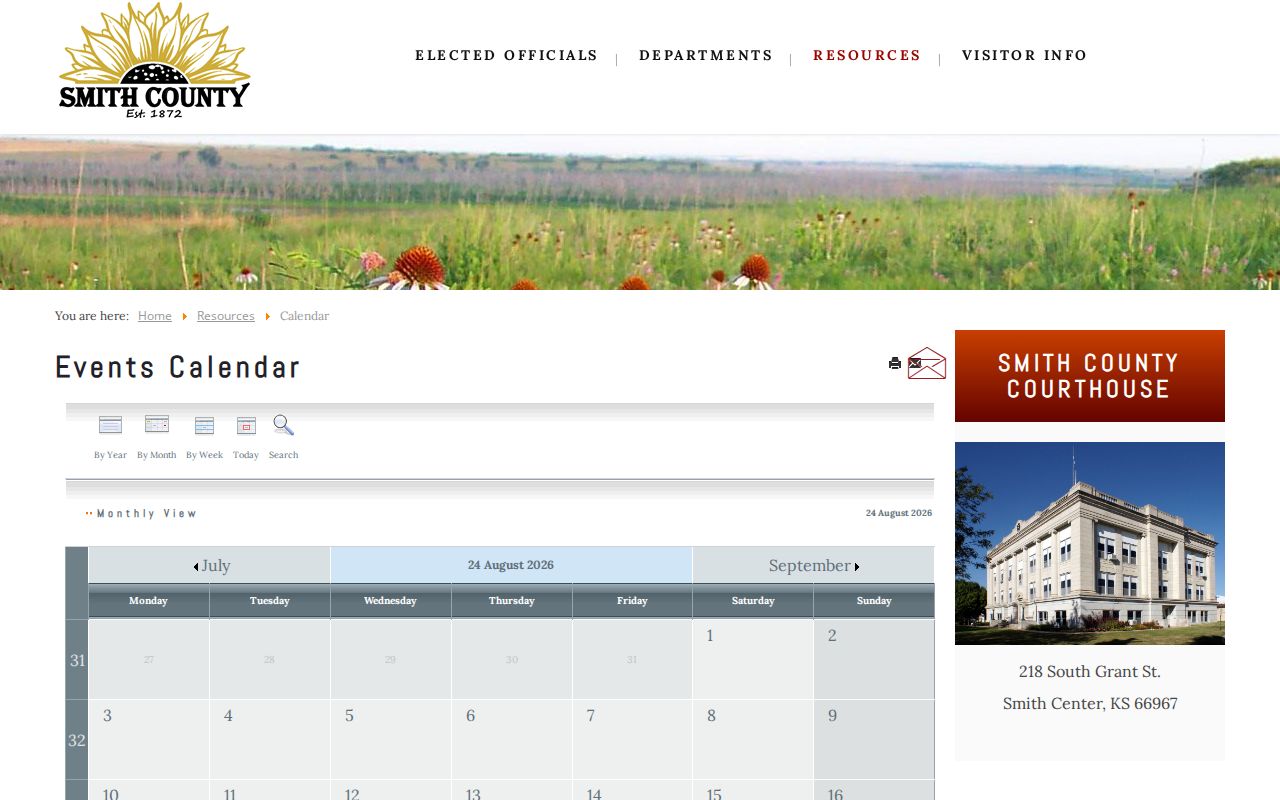
That calendar is handy for county meetings. It lists no case number, judge, courtroom, or hearing type. Do not count on it for a court appearance.
Calendar boundary: County events belong to county government. Court dates come from the case record, notice, or court clerk.
Smith County Court Date Lookups
Search by full case number, party name, or citation number. Pick the District and Smith County, then narrow to the right case category. Open the record and work through the hearing and event entries in date order. Do not treat any date as current yet. Look for a later reset, continuance, rescheduled entry, or signed order.
- Read the notice or citation.
- Search CaseSearch using the exact number or name.
- Select Smith County and the correct case type.
- Record the newest date, time, judge, place, and event label.
- Check for a later reset or order.
- Use the terminal or call the clerk when details conflict.
For Smith Center Municipal Court, call 785-282-3249. Other municipal matters belong with the city clerk who issued them, and a city session will never show up in the District county selector.
Smith Calendar Access Channels
Pick the channel that fits your question. CaseSearch is the free public index. Use it for a quick case lookup. The Rule 22 terminal can show more lawful public case information. For a certified docket entry, a notice, or an order, file a written Kansas court KORA request. The clerk counter and phone line work well when you just need to confirm the current record.
| Channel | Best use | Limit |
|---|---|---|
| CaseSearch | Public hearing dates and events | No stand-alone Smith calendar |
| Terminal | More public case detail | In-person access |
| Clerk phone | Current setting confirmation | Not legal advice or a new order |
| Written request | Copy of notice or setting order | Needs a precise record description |
The 17th Judicial District’s official court information illustrates the district terminal and records route.
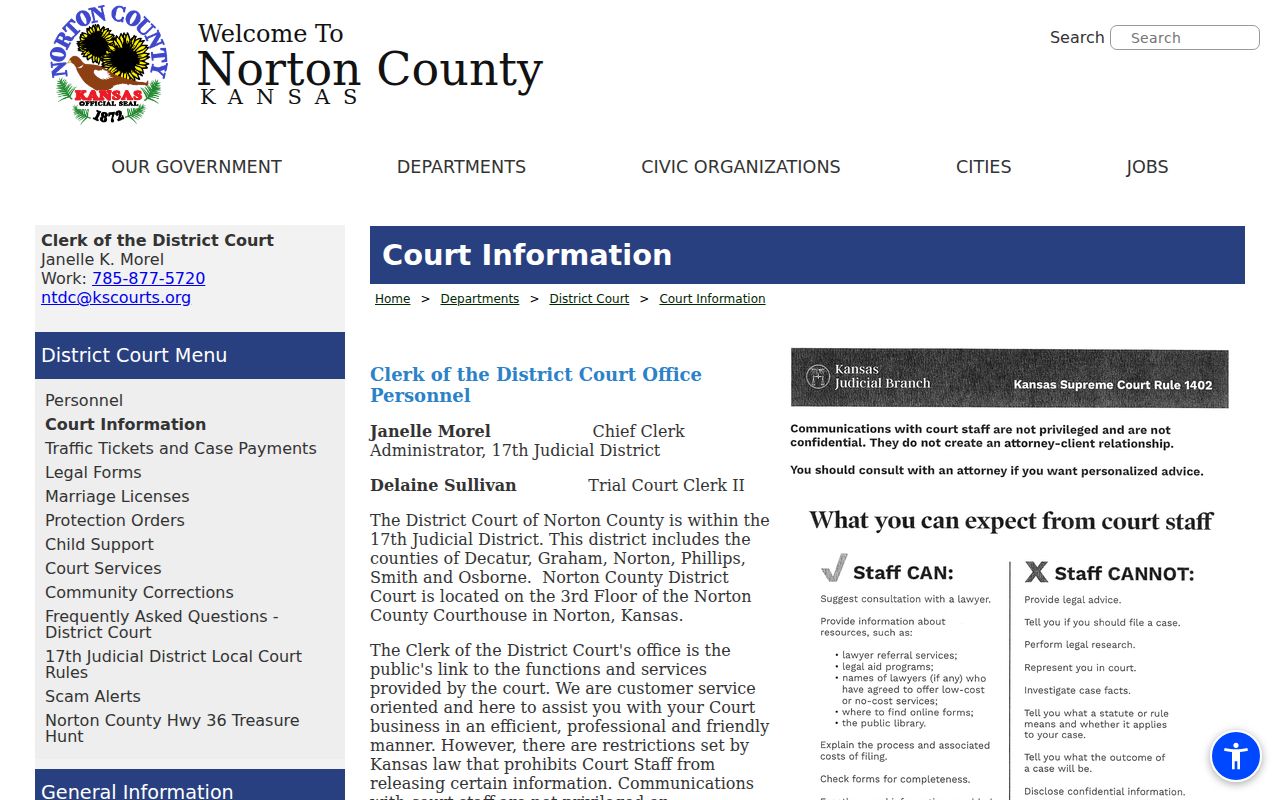
Since that page carries Norton branding, treat it as district context only and confirm the Smith-specific details with the Smith clerk.
Court Settings: What Each Field Means
A setting is a scheduled court event. But it is not always a trial. The docket may list a status conference, motion hearing, arraignment, pretrial, sentencing, review, bench trial, or jury trial. Smith County publishes no local codebook. Copy the exact event label, then describe it in plain language.
| Date and time | When the event is scheduled, subject to later court action |
|---|---|
| Court or location | The assigned venue when displayed |
| Judge | The judicial officer tied to the event |
| Setting type | The event’s exact portal or notice label |
| Case number | The record to which the setting belongs |
| Reset history | Older and newer dates that must be compared |
Judge name, courtroom, and event label are three separate fields. Reading one in place of another invites errors.
Smith Hearing Reminder Steps
Once you have the case pulled up, the official Kansas Hearing Reminders portal can send text-message alerts for hearings that allow them. Enroll there and the portal handles the rest.
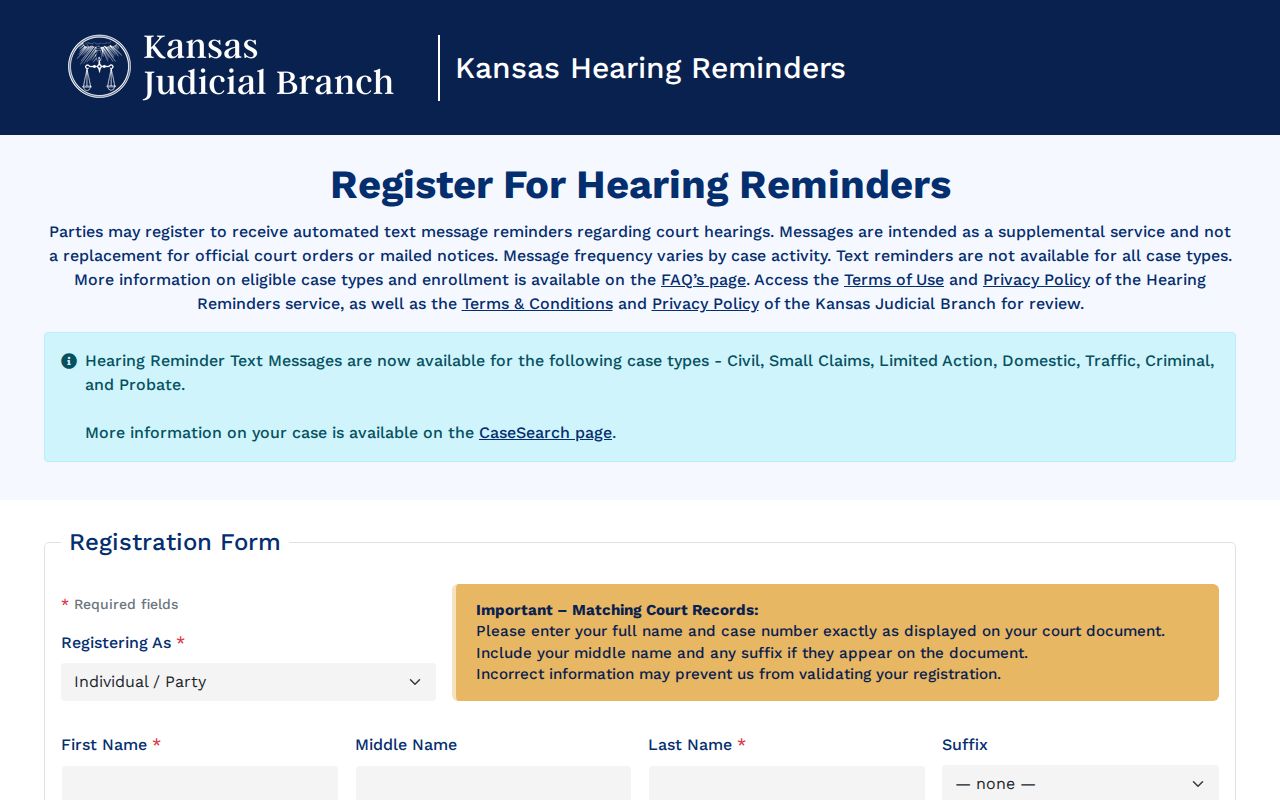
Treat any reminder as a convenience, nothing more. It cannot stand in for the court's notice, a signed order, the CaseSearch event, or a straight answer from the clerk. Availability for any given hearing should be checked against the live case. Enrollment was never completed here. Write the case number down first, along with the exact hearing date and time, before you sign up. If a reminder later clashes with an order, the order wins. Confirm the change with the clerk.
When a Smith Court Date Moves
Hearings move, and a docket will usually show both the old event and the new one. A continuance or reset shifts the date. The earlier entry often stays in the chronological index while the later entry becomes current. That word "reset" never means dismissed. CaseSearch currently offers no "current dates only" filter. Read the whole sequence in the court docket and find the newest order or notice yourself.
- Continuance
- A delay or move of a proceeding.
- Reset
- A later setting that follows an earlier date.
- Setting
- A scheduled event, not necessarily trial.
- Disposition
- The recorded case result, not a calendar change.
Weather and holiday closures can shift settings too. The Smith court posts no standing weather order and no remote-appearance page. So do not assume a phone or video option unless the court says so.
Smith Center Municipal Rhythm
In Smith Center, the city's own material calls the court docket the court schedule. The Municipal Court sits on the third Thursday of each month at the Srader Building. That applies unless otherwise stated. That is the standing rhythm. It belongs to Smith Center Municipal Court alone, not to the Smith County District Court calendar and not to any case-by-case online list of court dates.
For a specific Smith Center hearing, call 785-282-3249. Your citation or notice is still the first place to check for an individual appearance. Kensington, Gaylord, Lebanon, and Athol municipal matters go through their own city offices. No shared public city docket portal exists for those towns.
Note: "Unless otherwise stated" means the monthly pattern still needs current confirmation. Confirm it for a specific case.
Missed Settings and What Comes Next
A missed Smith County setting calls for quick action. Pull up the most recent case event on the docket and reread the notice. Then call the court named on that document. Assume nothing: cases are not dismissed automatically, new dates do not issue themselves, and paying online does not erase a missed appearance. The judge may enter an order or set a new event, so check the docket to see what action was actually taken.
Missed setting: Contact the District Court clerk at 785-282-5140, or the issuing municipal court, and follow the court’s current instruction.
Need proof of what happened? Ask the clerk for the relevant order or a certified docket entry. The clerk can point you to public record access but cannot give legal advice.
Smith Appellate Calendar Boundary
An appeal in Smith County gets its own appellate case number and its own record. One catch is worth knowing. The CaseSearch appellate selector warns that documents filed before March 13, 2025 are not available through the appellate public portal. It also lists some temporary category limits. That notice covers portal access only. It does not mean Smith District Court documents from before that date vanished. The Tenth Circuit page belongs to the federal appellate system. It has no role in a Kansas state appeal and no place on a state docket search.
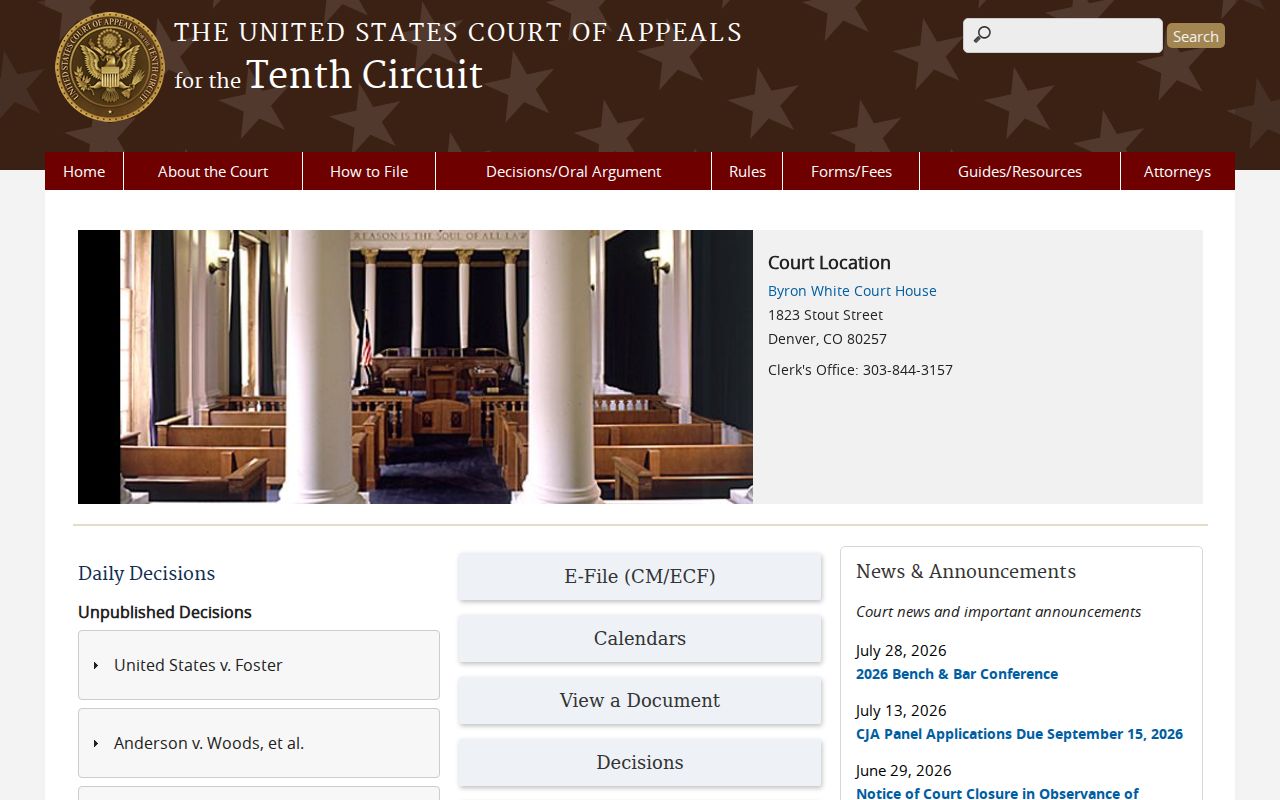
Smith County state appeals ordinarily go to the Kansas Court of Appeals or the Supreme Court under state rules. Federal appeal dates live on the separate federal docket.
Confirming a Smith Setting
The 17th Judicial District FAQ offers district context for terminal access and clerk limits.
Get your details straight before you drive to the courthouse. Write down the case number. Add your party role, the event label, the date and time, the judge, and the location. Bring the notice or citation with you. If two future dates show up, or a document is missing, call first. Travel conditions can affect court operations too.
One caution about payments. A payment page says nothing about a hearing date. Paying does not prove a setting moved or that your appearance was waived. Only three things control: the governing notice, a court order, and the current court record.
Smith Schedule Cross-Checks
Check one setting against more than one source. Compare the paper notice, the newest CaseSearch event, and any later signed order. Write down the case number, date, time, event label, judge, and location. If those sources disagree, call the Smith County District Court clerk. You can also call the issuing municipal court. The newest official court action wins. An old cached listing, a reminder text, or a payment page does not.
Need proof of the date for work or travel? A written request can get you the notice or order itself. Ask for that named record, not a general calendar printout. The Smith County events calendar will not work here. It lists county-government events, not case settings. The Central Payment Center is no help either. It only handles accepted payment records and cannot reschedule a hearing.
Heading to the courthouse terminal? Plan around the building's current access rules. Bring the full case number and your notice. A restricted case stays restricted at the terminal, since terminal access cannot override Rule 22. But if the case is public yet absent online, the terminal may show more. It may display more case information. Court staff can point you to the current public route. Still, only a judge can change the setting or approve a different way to appear.