
Smith County Court Docket Searches
For any Smith County District Court case, begin with Kansas Judicial Branch CaseSearch. Pick District as the level, choose a search type, type your term, then select Smith County when that control appears. A complete case number works best. The portal also searches by party, business, or citation, and lets you filter by case type, birth date, or filing date. District and appellate court records are covered. City municipal dockets are not.
Have the court name and any number from a notice handy. Newer Odyssey case numbers look like SM-2024-CR-000123. A broad name search can pull up more than one person, so narrow it with Smith County and a lawful filter. The online record is not a certified court file. When a deadline or appearance rides on it, confirm the setting with the clerk.
- Open CaseSearch, accept its user terms, and choose District.
- Select Case Number, Party Name, Business Name, Party As Business Name, or Citation Number.
- Enter the exact term, select Smith County, and add only useful filters.
- Read the case record and events index for filings, settings, and status.
- Use the courthouse terminal or district clerk when the needed public item is not online.
Smith County CaseSearch Controls
The public form keeps court level and search key separate on purpose. That split prevents a common mistake. Picking Appellate for a District Court case is one example. So is expecting the county list to include municipal courts. A human check must finish before the Search button works. If the button stays disabled or the challenge fails, that is a portal problem. It is not proof that no Smith County docket exists.
| Control | Smith County use | Key limit |
|---|---|---|
| Court | Choose District for local trial cases | Appellate is a separate search |
| Search Type | Use the most exact known identifier | Format changes by type |
| County | Select Smith County | It does not search city courts |
| Case Type | Criminal, Civil, Family, or Probate or Mental Health | Optional narrowing field |
| File dates | Limit results to a useful period | Not the hearing-date filter |
Court Dockets: What They Show
Think of a Smith County case record as an index. It is not the full stack of pleadings. Its case block lists the number, the court, the filing date, the case type and status, the parties, and the judicial officer where those fields are public. The events index then lines up filings, hearings, orders, judgments, and other acts by date. A setting means a court event was scheduled. Nothing more. The entry alone does not show the event happened or that the case ended.
| Case Number | The unique identifier, including year and case-type code in newer formats. |
|---|---|
| Parties | Publicly displayed names and roles, subject to access limits. |
| Events Index | The dated list of filed papers, hearings, orders, and court acts. |
| Hearing Settings | A scheduled date, time, type, and available location data. |
| Court and Judge | The tribunal and assigned judicial officer when displayed. |
| Disposition | The recorded outcome or status, which must be read with later entries. |
Reading Smith County Events
Docket entries use short terms for distinct procedural steps. "Filing" means a paper entered the court record. "Service" records delivery of process or notice. A continuance pushes a matter to a later date. A dismissal ends some or all claims without necessarily deciding the merits. "Judgment" is the court's decision, and "satisfaction" may later show the judgment was paid or fulfilled.
- Setting
- A scheduled court event, not proof that it was held.
- Entry
- One dated line in the chronological events index.
- Disposition
- The recorded result of a charge, claim, or case.
- Restricted
- Information withheld from public view by law, rule, or order.
Always read forward after a result. A later order, amended filing, appeal, or corrected entry can change the apparent status of the case. CaseSearch itself warns that internet access shows only information permitted for online display.
Smith County Courts and Dockets
Kansas runs a unified District Court system with no separate county-court tier. Smith County District Court sits in the 17th Judicial District and holds criminal, civil, family, probate or mental-health, juvenile, small-claims, state traffic, and related trial records. City municipal courts handle ordinance and municipal traffic cases. Federal matters belong to PACER and the federal courts, not the Kansas county selector.
| Court | Docket Covers | Where to Search |
|---|---|---|
| Smith County District Court | State trial matters and municipal appeals | CaseSearch, public terminal, district clerk |
| Municipal courts | City ordinances and municipal traffic | Issuing city clerk or court |
| Kansas appellate courts | Appeals and specified original matters | CaseSearch appellate selection |
| Federal courts | Federal district, bankruptcy, and appeals | PACER or the federal clerk |
Smith County District Structure
K.S.A. 4-218 places Smith County alongside Decatur, Graham, Norton, Osborne, and Phillips Counties in the 17th Judicial District. Administrative grouping is not a merged public docket, though. A Smith filing still calls for choosing Smith County in the search. Under assignments and local rules, district judges and magistrate judges may serve across the district.
The official statute page shows the district grouping:
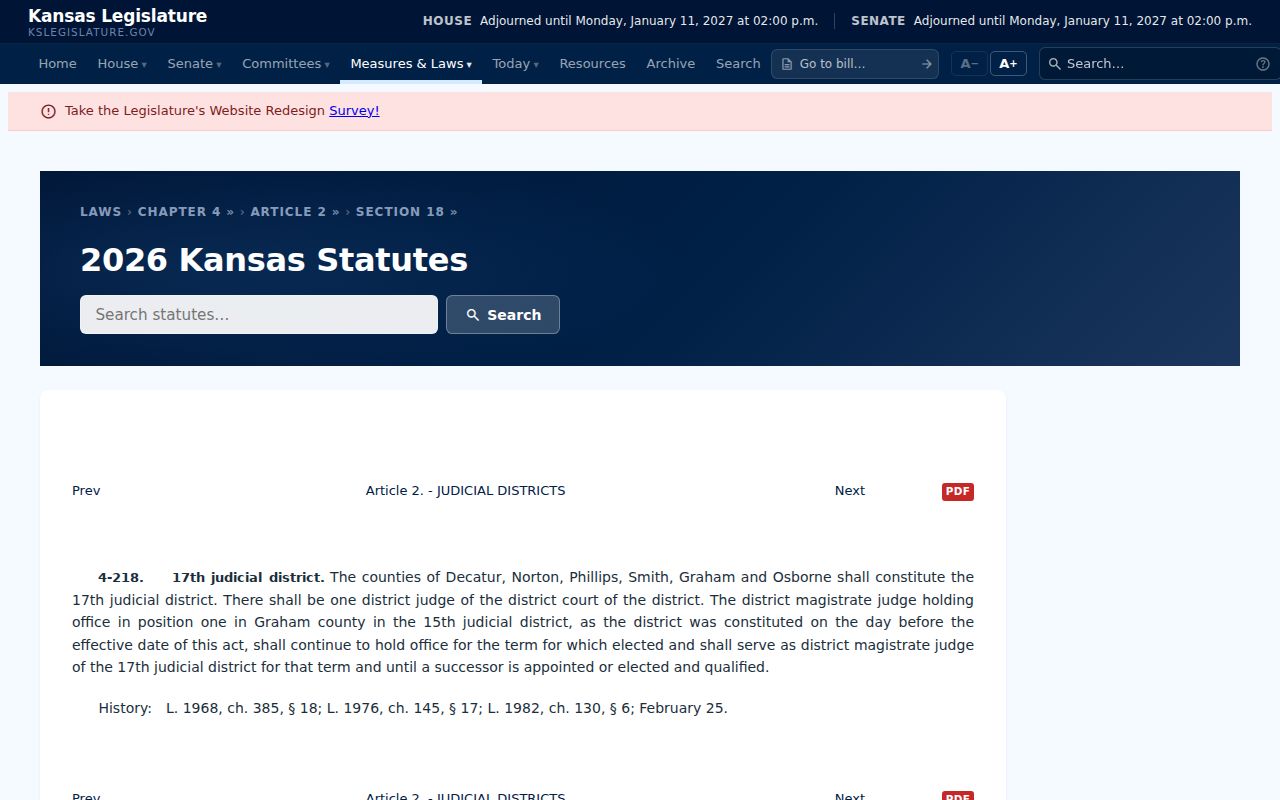
That is why a six-county judicial district and a county-specific case search are two different choices. They are related, but they are not the same thing.
Smith County Court Dates and Settings
The official Smith County government calendar is a community calendar, not a judicial hearing list. Start with the events and settings inside the case record. Then confirm the date with the Clerk of the District Court at 785-282-5140. The public terminal offers another route to public setting data. For a municipal date, check with the issuing city. City cases are not folded into the District Court county search. A reset, continuance, cancellation, or later order can displace an older setting. Read every later entry before trusting the first date you find. Kansas also runs an official hearing-reminder service. A reminder never replaces the court's order. Nor does it replace the clerk's confirmation. The full Smith County court schedule walkthrough separates each channel and explains setting fields.
Smith County Courthouse Access
Most Smith County docket business happens at the courthouse. The address is 218 South Grant Street in Smith Center. Mail goes to PO Box 273, Smith Center, KS 66967. Once inside, look for the Clerk of the District Court. That office, not the elected County Clerk, keeps the district court records. The two share the building but split the files between them. Kansas Supreme Court Rule 22 also applies. It entitles the public to a terminal there. That terminal covers electronic case records and the events index. For the wider county picture, try the official Smith County home page. It posts county offices and services.
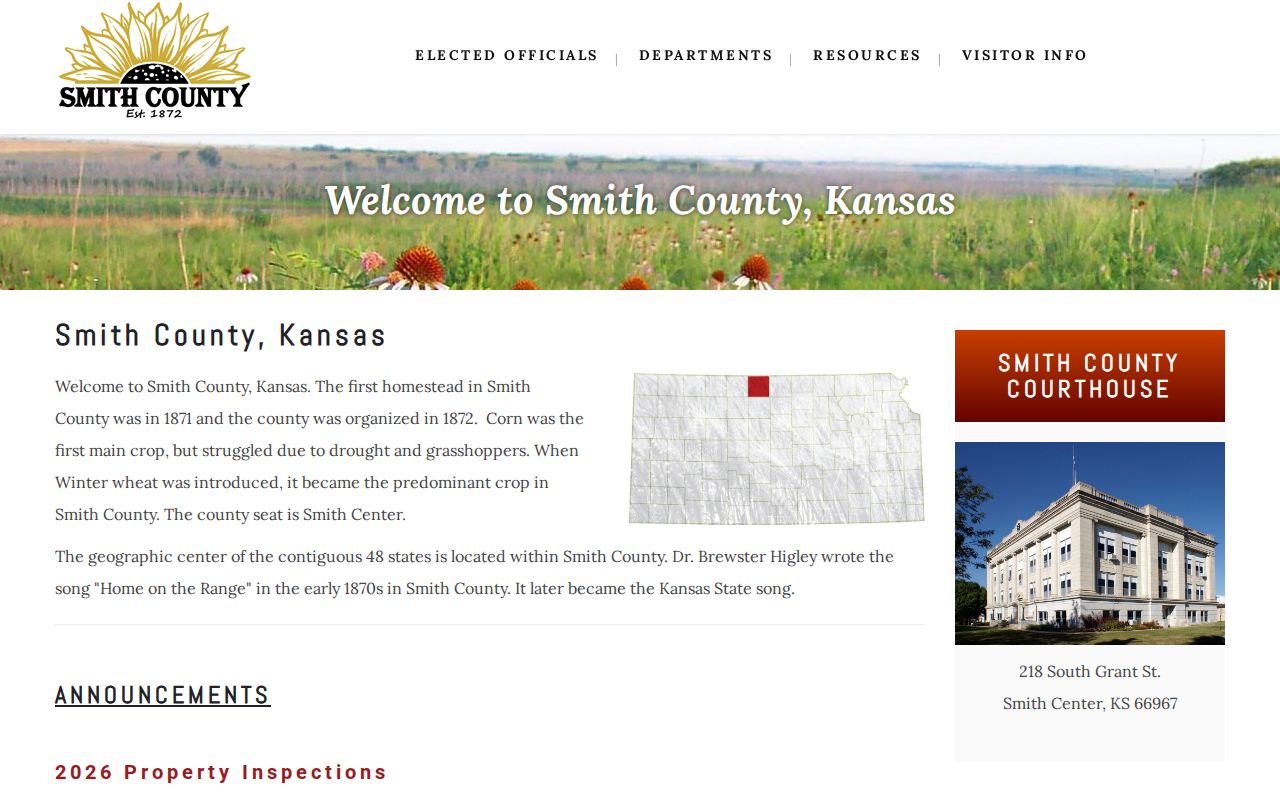
The county page helps you find the building. For case information, the judicial counter and CaseSearch remain the sources.
Clerk of the District Court
218 S. Grant St., PO Box 273
Smith Center, KS 66967
785-282-5140
Fax: 785-282-5145
Docket Access Under Kansas Law
Court rules, statutes, and the custodian's duties drive public access. Rule 22 governs electronic case records. It covers both district and appellate records. It distinguishes internet portal access from courthouse-terminal access. The Kansas Open Records Act supplies a request and response framework. It does not erase court-record restrictions. Sealed matters, juvenile records, protected personal data, and other nonpublic material stay unavailable.
Key Rules:
K.S.A. 45-218 requires prompt action and an explanation when access cannot be given by the end of the third business day.
K.S.A. 45-219 permits copy charges and an advance fee when authorized.
K.S.A. 45-221 lists exemptions and calls for open portions to be separated when practical.
Restricted Smith County Dockets
A blank result does not prove the case is absent. That is true in any Smith County court docket search. Sealed files, restricted case types, and records kept off the internet can all hide a case from view. A filing under a different name can do the same. So can an older matter past the online document window, or a case sitting in municipal court. Rule 22 lets the public terminal show some material the internet never displays. It still shields nonpublic material even at that terminal.
Expungement can close off qualifying criminal records under Kansas law. Juvenile, adoption, care and treatment, and protected family cases face their own limits. Ask the clerk how to reach the public material. Do not ask the clerk to explain a judge's reasoning. When the Kansas Open Records Act applies, a written denial should state the legal ground. That ground explains the withholding.
How Smith County Keeps Records
Smith County splits its records between two offices. The Clerk of the District Court keeps the judicial records. Judgments, pleadings, and the certified district docket sit there. The elected County Clerk, Ashley Maxwell, keeps administrative, election, and government material instead. So a case record request belongs at the judicial counter. County commission or election papers belong with the County Clerk.
District requests go in person, by mail, or by fax under 17th Judicial District guidance. Give the case number and the exact document whenever you can. The district reference lists free terminal searching and 25 cents per printed page. A larger request may draw a $5 research charge. Certification adds $1. Confirm Smith follows the cited practice and get a quote before paying.
Smith County District Court Clerk
218 South Grant Street, PO Box 273
Smith Center, KS 66967
785-282-5140
Ask for the judicial record counter.
Smith County Court Services
Court Services sits at the courthouse address. It handles supervision and reporting. It is not the docket counter. That matters when a reader hops from a 17th Judicial District agency page. The reader may assume any court office can print a case record. Take docket and copy questions to the District Court clerk instead.
The official 17th Judicial District Court Services page identifies the Smith County office. Its contact details appear there too.
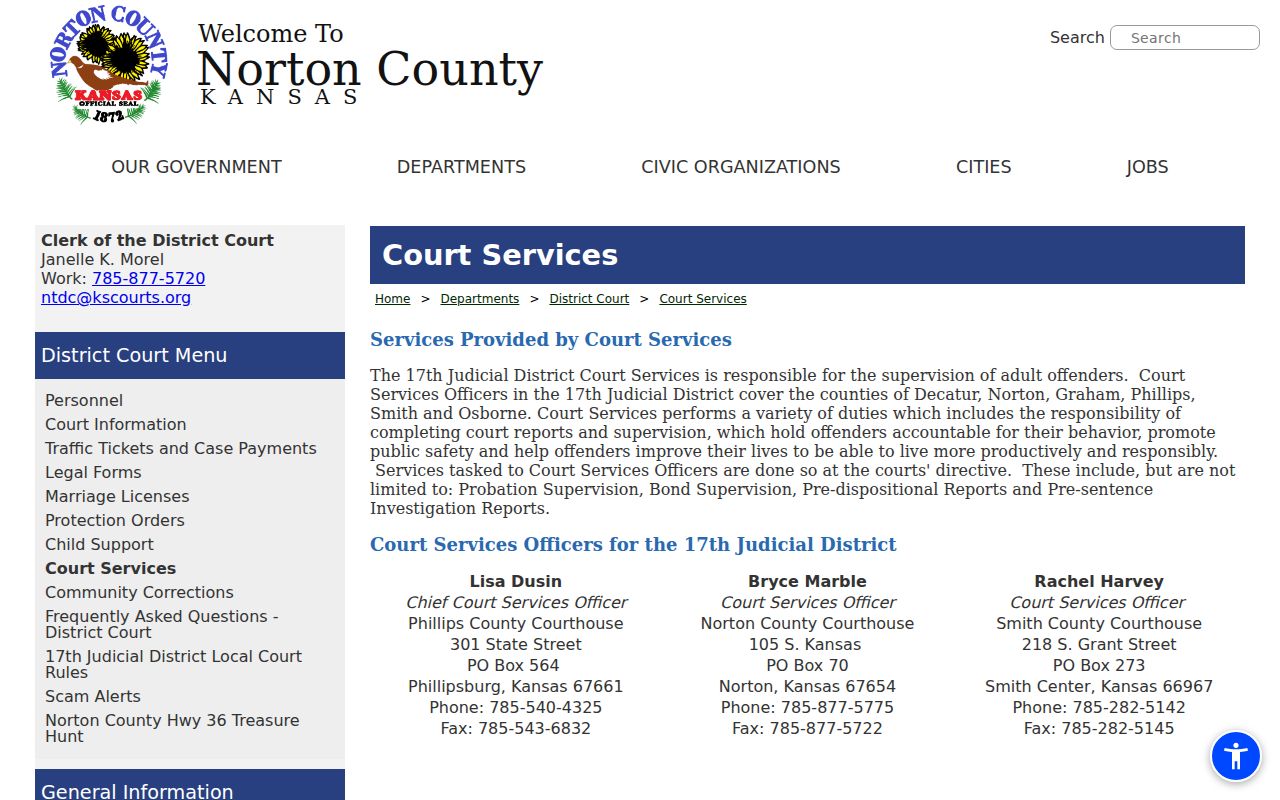
Court Services listing: The entry confirms the local service point while keeping supervision work separate from record custody at the clerk's counter.
Smith County Docket Technology
Smith County now runs inside Kansas's statewide eCourt and Odyssey environment, which the 17th Judicial District joined. That shift explains the newer county-prefixed case numbers and the shared public CaseSearch interface. Kansas Courts eFiling, known as Tybera eFlex, is the channel attorneys use to file. It is not a public docket viewer. A filing may move through eFlex into court administration. It can later surface as an event in CaseSearch. The two products serve different users.
The courthouse route has not gone away. Older files may still need the terminal. Document images and public data kept off the internet may need a clerk request. The official record stays with the court, never with a saved portal result or a screen capture.
Your search route depends on the number in hand. A full Odyssey district number works as a case-number query in CaseSearch. A state citation may fit the citation option or the Kansas Central Payment Center. That route works when payment is allowed. A municipal citation should be read for the issuing city first. CaseSearch offers no Smith Center, Kensington, Lebanon, Gaylord, or Athol municipal selector. If a city judgment is appealed under K.S.A. 22-3609, the later District Court case gets its own statewide record. The original city file does not move into the state portal.
Portal access and document access are separate things. A public result may list parties, status, and events while withholding the underlying document images. Note the case number, event date, and document description before you call the clerk. A precise Smith County request is easier to price. It is less likely to land with the wrong office. If the portal goes down, the public terminal and the clerk remain the official fallback. A private name-search service does not take their place.
Smith County Court History
Smith County was organized in 1872. Smith Center became the county seat. The limestone courthouse on the square went up between 1918 and 1920. That span explains a lot. An old Smith County court record may cross paper, microfilm, and electronic eras. A portal search alone is not an archives search.
The Kansas Historical Society county profile supplies the deeper historical background.
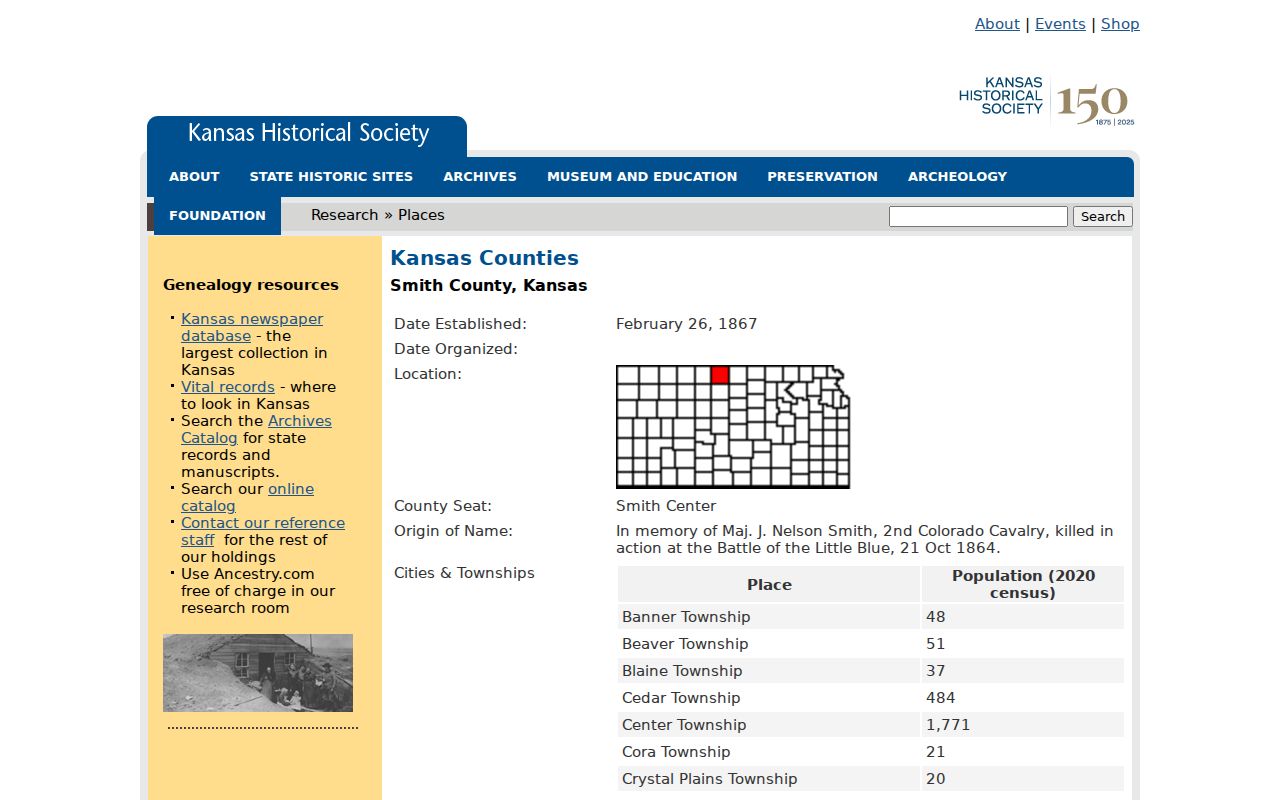
The historical record gives local context. The District Court clerk remains the right source for an old judicial file.
For an older Smith County docket, give the clerk the names, the approximate filing year, and the case type. Add any number you already have. Ask first whether the index sits at the public terminal. Then request only the specific public pages you need. That narrow approach helps the clerk locate the file and prepare an accurate cost estimate.
City-by-City Court Dockets
Municipal courts handle city ordinance matters and municipal traffic cases. These sit outside the Smith County District Court search. The five city pages follow the 2020 Census ranking: Smith Center, Kensington, Lebanon, Gaylord, and Athol. What each city offers differs. Smith Center publishes a court page and fine procedures. Kensington, Lebanon, and Athol take a contact-first route. Gaylord documents electronic court-fine payment but no public case lookup. A state citation or a municipal appeal can still land in District Court instead.
Smith Center Court Records
1,571 · Published municipal court and payment guidance
Kensington Court Records
399 · City office and ordinance archive route
Lebanon Court Records
178 · Municipal contact fallback
Gaylord Court Records
87 · Court-fine payment documented, lookup unverified
Athol Court Records
41 · Verified municipal contact route
Map and Directions to the Smith County Courthouse
The Smith County Courthouse at 218 South Grant Street in Smith Center holds the Clerk of the District Court's docket and case files, along with Smith County Court Services and the separate county-government Clerk's office. Ask for the "Clerk of the District Court" at the counter, since visitors sometimes default to the county clerk instead. The limestone courthouse dates to the 1918-1920 period and remains the county's civic landmark and only district-court location.
Smith County Courthouse
218 South Grant Street
Smith Center, KS 66967
785-282-5140
Fax: 785-282-5145
Monday through Friday, 8:00 a.m. to 5:00 p.m.
No Smith-specific lunch closure, parking map, or building security policy is published, so call 785-282-5140 before traveling to confirm same-day terminal or copy access and to ask about entry rules and parking.